
How to identify a Vintage Car Radio?
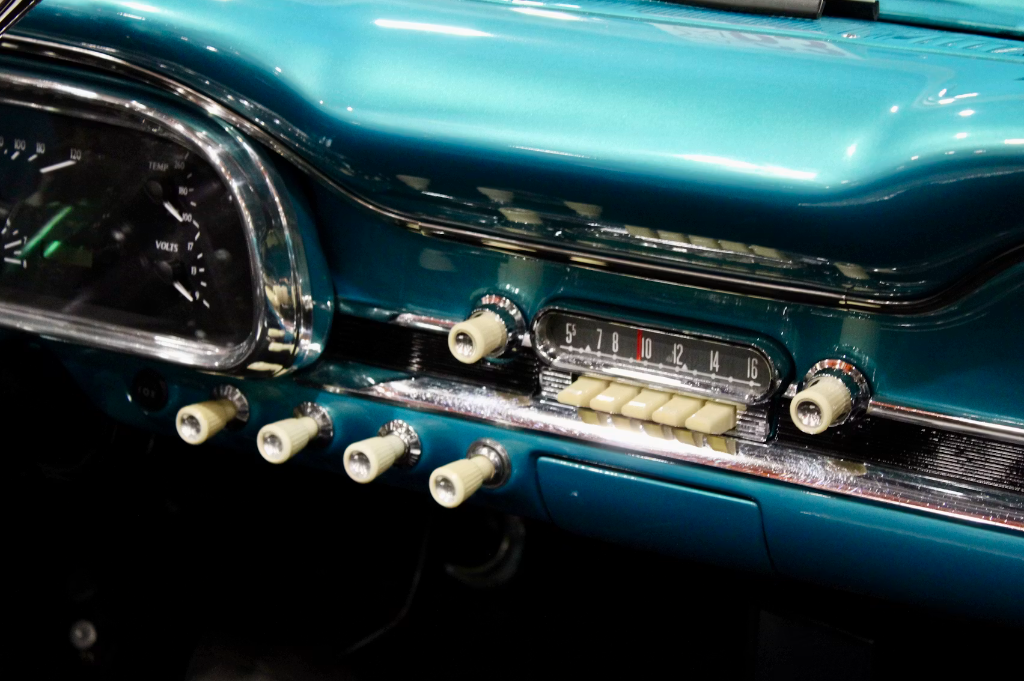
What Is This Thing? A Practical Guide to Identifying Your Vintage Car Radio
It shows up in a box from an estate sale. Or it falls out of the dash when you’re pulling apart a barn-find project car. Or your uncle hands it to you with a look that says “I’ve had this for forty years and I have no idea what it is.” Sound familiar? Welcome to vintage car radio identification — a hobby within a hobby that is equal parts detective work, archaeology, and mild frustration.
Over the years I’ve identified hundreds of vintage car radios for customers, collectors, and the genuinely puzzled. And I’ll tell you the good news upfront: with the right tools, what looks like an impossible mystery usually isn’t. The bad news? Those tools require a little patience and a willingness to do more than just Google “old car radio chrome knobs.” Trust me, I’ve seen what that search returns.
This guide walks you through the identification resources we’ve built at Retro Radio Shop — covering everything from tube-era sets of the 1930s through the transistorized radios of the early 1970s. By the end of it, you’ll either know exactly what you have, or you’ll at least know how to find out.
Why Identification Even Matters
Before we get into the how, let’s talk about the why — because I get this question occasionally from people who just want the thing to work and don’t particularly care what it’s called.
Here’s why it matters: a vintage car radio is not a universal appliance. The mounting dimensions, the wiring harness configuration, the voltage requirements, the speaker impedance — all of these differ by make, model, and year. A 1955 Chevrolet radio does not drop into a 1955 Ford hole. A 1968 Pontiac radio will not wire up the same as a 1968 Dodge. And if you’re sending a radio to us for repair or a Retro-RAD upgrade, we need to know what we’re working with before we can quote the job.
Beyond the practical side, there’s the collector angle. An identified radio — with year, make, model number confirmed — is worth more than an unidentified mystery unit. It can be properly described. It can be matched to a specific vehicle. It can be given back the context it deserves.
The radios covered by our identification database span roughly 1930 to 1973. That’s tube-era sets (6-volt positive ground, external speakers, enormous transformers), through the transitional era of hybrid designs, into the fully transistorized solid-state sets of the 1960s and early 70s. Each era has its own identification quirks. A 1938 Buick radio looks nothing like a 1965 Buick radio — but both are in the database.
The Four Tools in Your Identification Arsenal
We’ve built four distinct lookup tools into the Retro Radio Shop identification database. Think of them as four different angles of attack on the same problem. Most radios can be cracked with one of them. Stubborn ones may need two or three. Honest instructions on how to use each one are included below — not just a link and a prayer.
This is the visual approach — and honestly, it’s where most people should start. If you have the radio in front of you and can compare it to a photograph, you’ll often get a match within a few minutes. The database covers OEM (Original Equipment Manufacturer) radios organized by vehicle make. Brands covered include Buick, Cadillac/LaSalle, Chevrolet, Chrysler, DeSoto, Dodge, Edsel, Ford, Hudson/Terraplane, Imperial, Kaiser/Frazier, Lincoln/Continental, Mercury, Nash/Lafayette, Oldsmobile, Packard/Clipper, Plymouth, Pontiac, Rambler/AMC, Studebaker, and Willys/Jeep — plus GM and Ford trucks.
Navigate to the make that matches your radio using the tabs at the top of the page. The radios are displayed with a photo, year, series, voltage, and model number. Scroll through the images for your make until you find a faceplate that matches. Pay close attention to the dial scale shape, knob positions, and chrome trim details — these vary significantly by year even within the same brand. Use your browser’s Find feature (Ctrl+F / Cmd+F) to search for a year or partial model number if you have that information.
You’ve got a number but no idea what it means. This is the tool for that. If the previous owner was helpfully organized — or the radio still has its original service tag — you may have a model number right there on the chassis. This search lets you go straight to the answer without scrolling through hundreds of photographs. It’s the fast lane, assuming you have the ticket.
Find the model number on your radio — typically stamped or printed on a label on the back of the chassis, sometimes on a tag on the side, occasionally embossed directly into the chassis metal. Enter it here. Even a partial number will often get you close. Delco numbers for GM vehicles typically look like 985xxx or 987xxx. Motorola numbers use alphanumeric combinations like 5MX11. Bendix/Philco numbers have their own formats. If the label is missing, check the chassis itself — numbers were sometimes stamped directly into the metalwork.
Not all vintage car radios are OEM factory units. A significant portion of what ends up on workbenches — and in estate sale boxes — are aftermarket universal radios: units sold by brands like Motorola, Blaupunkt, and others that were installed by dealers or owners as upgrades or replacements. These units don’t belong to a specific vehicle make and won’t appear in the OEM image search. This tool covers them by brand. If your radio has a prominent brand name on the face that isn’t a car manufacturer, start here.
Navigate to the aftermarket brand that appears on your radio’s faceplate or chassis. Common brands include Motorola, Blaupunkt, Clarion, Craig, Delco, Jensen, and others. Browse the listings for your brand to find a visual or model number match. Universal radios are particularly common in trucks, older imports, and vehicles where the original radio was replaced decades ago by a previous owner who thought they were upgrading.
This is the reference librarian’s tool — deep, structured, and enormously useful when you know what you’re looking for but need to confirm the details. The manufacturer charts lay out model number sequences by year and application, allowing you to trace a number through the production history of a given manufacturer’s radio line. Delco, Motorola, Bendix, Philco, Collins — the major suppliers to the auto industry are all represented.
Select the manufacturer from the chart list and scan the model number ranges to determine approximate year and application. Particularly useful when you have a partial number, or when the radio’s physical condition makes visual identification difficult. Also invaluable for cross-referencing: if a Delco number was used across multiple GM brands (Buick, Oldsmobile, Pontiac), the chart will tell you — which explains why that “Pontiac” radio looks suspiciously like an Oldsmobile.
When the Database Doesn’t Have It
The database is extensive, but no database is complete. Vintage car radios were produced in enormous variety — different trim levels within the same model year often had different radios, and there are regional variations, late-production changes, and one-off configurations that never made it into any published reference. If you’ve worked through all four tools and you’re still stuck, don’t panic.
One of the genuinely best resources in the hobby is the Vintage Car Radios Facebook group . It’s an active community of collectors, restorers, and enthusiasts who have, between them, probably seen every radio ever installed in a North American vehicle from 1930 to 1975. Post a clear photo of the front face, a photo of the back of the chassis, and any numbers you can find — and you will typically have an answer within a few hours. The collective knowledge in that group is remarkable, and the members are genuinely helpful. Just don’t show up asking what your radio is “worth” without also showing up with some context. That’s a separate conversation.
You can also contact us directly at info@retroradioshop.com . If you’re sending a radio to us for repair or upgrade, include photos and any numbers you can find — we’ll identify it as part of the intake process.
Tips From Someone Who Has Squinted at a Lot of Chassis Labels
The chassis back is where the important numbers live. Before you power it up, before you start probing, before you do anything — turn it over, find the label or stamping, and photograph it. Labels fall off. Stampings corrode. You may only have one shot at a legible number.
Vehicles up through the mid-1950s were typically 6-volt positive ground systems. If you have a tube radio from a pre-1956 vehicle, it almost certainly ran on 6V positive ground. Connecting a 6V positive ground radio backwards to a modern 12V negative ground bench supply will ruin your afternoon. The year and the voltage are connected.
Decades of previous owners, well-meaning mechanics, and teenage experimenters mean that the faceplate you’re looking at is not necessarily original to the chassis behind it. If the visual search gets you close but not exact, check whether the chassis numbers match the faceplate. Sometimes someone put a 1959 Chevrolet face on a 1961 chassis because “it fit.” People are creative like that.
GM vehicles in particular had multiple numbering systems applied to the same radio — the Delco electronics number, the GM part number, and sometimes a Fisher Body assembly number. If one search doesn’t find it, try the other numbers. They’re all on there; you may just need better lighting and possibly reading glasses.
GM trucks, Ford trucks, Dodge trucks, and International trucks had their own specific radio lines separate from their car counterparts. If you’re working on a truck, use the truck-specific sections of the image database. You’ll save yourself fifteen minutes of increasingly frustrated scrolling through car radios that don’t look quite right.
Once You Know What You Have
Identification is the beginning, not the end. Once you know what you’ve got, you have options.
If the radio is complete and in restorable condition, a proper recap and alignment will typically bring it back to original specification. That’s the path for collectors, concours entrants, and anyone who wants the authentic experience of an AM tube radio in their classic car — drift, warmth, selectivity quirks and all. There’s genuine magic in it.
If the radio is a good candidate for modernization — or if AM-only reception with three stations and a lot of agricultural programming doesn’t appeal to you — a Retro-RAD upgrade installs FM, Bluetooth, and auxiliary input capability through the original faceplate and controls. The car looks right. The radio sounds modern. Nobody has to compromise.
Whether you’re looking at a repair, a Retro-RAD conversion, or just trying to understand what you’ve got before you decide, get in touch. We assess radios, give honest recommendations, and do the work properly. Contact us at info@retroradioshop.com .
Stuck on an identification? Drop us a line at info@retroradioshop.com . We’re happy to take a look.
© Retro Radio Shop — Technical Reference Series