
Dog bone and molded fixed resistor color coding calculator

Vintage Dog Bone Resistor Color Code Guide
Read and calculate any antique resistor — body-end-dot, flexible, or banded styles
How the RMA Color Code Works
The RMA (Radio Manufacturers Association) resistor color code system uses three (and sometimes four) colors to indicate the resistance value in ohms. Different manufacturers arranged these colors in several patterns on dog bone, molded, and flexible resistors, but the underlying system is always the same:
- First figure of the resistance value
- Second figure of the resistance value
- Multiplier — the number of zeros after the two figures
- Tolerance (optional) — Gold = 5%, Silver = 10%, no color = 20%
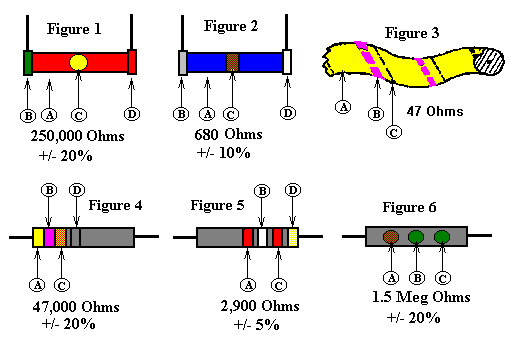
RMA reference chart — Figures 1–6 show the three resistor styles covered below
Color Code Reference
| Color | Digit Value | Multiplier (zeros) |
|---|---|---|
| Black | 0 | 1 (none) |
| Brown | 1 | 10 |
| Red | 2 | 100 |
| Orange | 3 | 1,000 |
| Yellow | 4 | 10,000 |
| Green | 5 | 100,000 |
| Blue | 6 | 1,000,000 |
| Violet | 7 | 10,000,000 |
| Gray | 8 | 100,000,000 |
| White | 9 | 1,000,000,000 |
| Tolerance Color | Percentage |
|---|---|
| Gold | ±5% |
| Silver | ±10% |
| None | ±20% |
Style 1: Body-End-Dot / Body-End-Band (Figures 1 & 2)
The most common dog bone style. The body color gives the first digit, one end gives the second digit, a center dot or band gives the multiplier, and a tolerance band at the opposite end gives the tolerance.
Style 2: Flexible Fabric-Covered (Figure 3)
Wire-wound resistors covered in fabric. The body color gives the first digit, the thickest thread (triple-wound) gives the second digit, and the thinnest thread (single-wound) gives the multiplier. If a thread is missing, assume it matches the body. No tolerance marking (assume 20%).
Style 3: Consecutive Banded (Figures 4, 5 & 6)
Later molded resistors with axial pigtail leads use three or four consecutive colored bands read left to right: Band A = first digit, Band B = second digit, Band C = multiplier, Band D = tolerance. Dot-style mica resistors (Figure 6) use the same A-B-C sequence.
Notes for Collectors
K = thousand ohms (1K = 1,000 Ω). M = million ohms (1.5M = 1,500,000 Ω). On some early schematics, the letter M was sometimes used to mean 1,000 rather than 1,000,000.
Some manufacturers (notably Philco) used mercury-vapor factory lighting, making certain colors hard to distinguish. They used odd-value resistors (e.g. 51K instead of 50K) so every code color would be clearly visible. In most cases, the next higher or lower standard value can be safely substituted.